BioGraphFusion: Graph Knowledge Embedding for Biological Completion and Reasoning

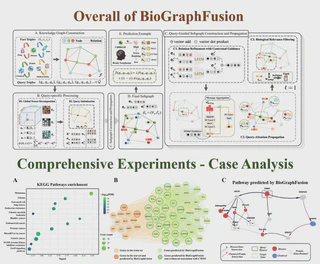 BioGraphFusion Framework
Note: This work was completed during my undergraduate studies and represents my early research experience in graph neural networks and biological knowledge graphs.
Overview
Motivation: Biomedical knowledge graphs (KGs) are crucial for drug discovery and disease understanding, yet their completion and reasoning are challenging. Knowledge Embedding (KE) methods capture global semantics but struggle with dynamic structural integration, while Graph Neural Networks (GNNs) excel locally but often lack semantic understanding.
Results: We introduce BioGraphFusion, a novel framework for deeply synergistic semantic and structural learning. BioGraphFusion establishes a global semantic foundation via tensor decomposition, guiding an LSTM-driven mechanism to dynamically refine relation embeddings during graph propagation. Experiments across three key biomedical tasks demonstrate BioGraphFusion’s superior performance over state-of-the-art KE, GNN, and ensemble models.
Key Contributions
- CP decomposition-based global semantic modeling that establishes a semantic foundation to guide subsequent dynamic structural reasoning
- LSTM-driven context-aware relation refinement mechanism that dynamically fuses entity contexts through gating systems
- Query-guided subgraph construction with biological relevance filtering for precise and efficient reasoning
Citation
@article{lin2025biographfusion,
  title={BioGraphFusion: Graph Knowledge Embedding for Biological Completion and Reasoning},
  author={Lin, Yitong and He, Jiaying and Chen, Jiahe and Zhu, Xinnan and Zheng, Jianwei and Tao, Bo},
  journal={Bioinformatics},
  pages={btaf408},
  year={2025},
  publisher={Oxford University Press}
}
